

Summary
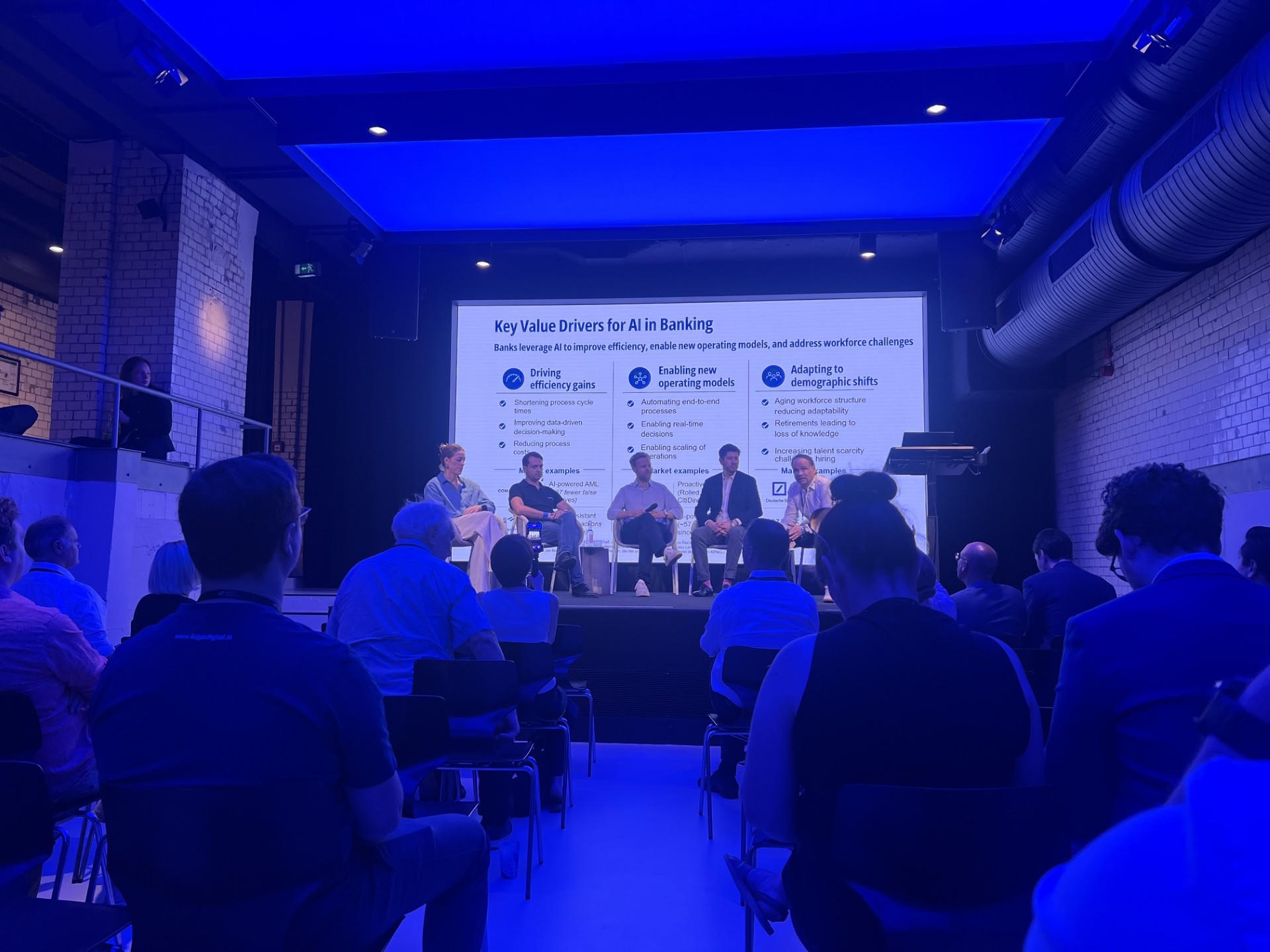
On 2 July 2026, Ohpen attended the Next Banking Summit (NBS) in Berlin, joining around 350 participants from across banking, fintech and technology. The conversations covered many of the challenges facing financial institutions today, but three themes stood out: the changing role of AI, the move towards modular banking infrastructure, and the opportunities emerging around Open Finance.

Why did Ohpen attend the Next Banking Summit in Berlin?
Germany is a key market for Ohpen’s further expansion, and Berlin is at the centre of the country’s fintech ecosystem. The Next Banking Summit, organised by the House of Finance and Tech (HoFT), brought together banks, fintechs and technology providers to exchange perspectives on where the industry is heading.
For Ohpen, it was an opportunity to follow the latest developments, exchange ideas with the wider banking community and build new relationships in the German market.
Three themes in particular stood out, and each has implications for the technology decisions financial institutions are making today.
AI is moving from assistance to action
Artificial intelligence was naturally one of the main topics of the summit. But the discussion went beyond AI copilots that simply support employees.
We are seeing a shift towards AI systems that can independently handle operational tasks under human supervision. The question is therefore becoming less about whether banks should use AI and more about which decisions and actions AI should be allowed to perform, and under what governance framework.
This has significant implications for banking technology.
As AI moves closer to operational processes, banks need more than access to the latest models. They need structured and accessible data, systems that AI can interact with, and the governance and auditability required to understand what happened, why and when.
The ability of core banking systems to integrate with AI models and agents may therefore increasingly become a hygiene factor rather than a differentiator.
The takeaway:
AI readiness starts with the underlying technology architecture. Banks with systems that make data and functionality accessible will be better positioned to move from experimenting with AI to applying it within real banking processes
Modularity is becoming an operating advantage
Another strong theme was the growing importance of infrastructure decisions. Time-to-market matters, and increasingly it is all about execution.
The discussions pointed towards a future in which banking technology consists of interchangeable services connected through APIs, allowing banks to select individual solutions rather than depending entirely on monolithic software packages.
That increases the importance of cloud-native deployment, standardised integration frameworks, interoperability and API-based architecture.
But modularity is not simply an architectural decision. It directly affects how quickly a financial institution can respond to change.
When capabilities can be introduced, replaced or extended independently, banks have more freedom to evolve their technology landscape without turning every change into a large transformation programme.
The takeaway:
The value of modular banking infrastructure is ultimately speed and flexibility. Technology needs to support the operating model of the bank, allowing institutions to introduce new capabilities and propositions as their strategy and the market evolve.

Open Finance is bigger than compliance
FIDA and PSD3 were also prominent topics, but the conversation went beyond regulation.
Rather than seeing Open Finance purely as a compliance requirement, speakers discussed its potential to enable completely new business models. Future competitive differentiation could increasingly come from embedded financial services, personalised financial products and ecosystem partnerships, underpinned by customer-controlled data sharing.
Banks with high-quality APIs could increasingly operate as participants in broader financial ecosystems rather than as isolated institutions.
The ability to connect securely and efficiently with third parties therefore becomes both a technology capability and a strategic one.
The takeaway:
Regulation may provide the catalyst for Open Finance, but the bigger opportunity lies in what financial institutions can build once data and services can move more easily between organisations.
The common denominator: readiness
The three conversations may appear to be about different things, but they depend on many of the same foundations.
AI needs accessible data and systems it can interact with. Modular banking requires interoperable services and APIs. Open Finance depends on secure connectivity and the ability to exchange data across ecosystems.
For banks, this makes technology architecture increasingly strategic. The question is not simply which technology trend will arrive next, but whether the foundations are in place to respond when it does.
The direction coming out of Berlin was clear: banking technology is becoming more modular, more connected and increasingly intelligent. Financial institutions that prepare their architecture for that reality today will have greater freedom to adapt to whatever comes next.
About HoFT
The House of Finance and Tech (HoFT) was founded in 2024 with the ambition of strengthening Berlin’s position as an international hub for financial and technology innovation. Initially funded by the State of Berlin through IBB, HoFT is now financially independent and privately held, with around 70 member companies as of August 2026.
HoFT brings together banks, fintechs, startups, regulators and other industry participants through its community and its campus in Berlin-Prenzlauer Berg. Its activities include the NBS in summer, the Finwell Summit in winter, regular community events, and dedicated focus and working groups addressing current industry topics.
Members also gain access to HoFT Intelligence, including proprietary research and reports, as well as the continuously expanding Finwell database.